German market archive. This article covers gambling rules and news in Germany. It does not describe the law in Ireland, where gambling is overseen by the Gambling Regulatory Authority of Ireland (GRAI).
The operator of the online casinos JackpotPirates and BingBoom has opted for a study on online gambling in Germany. DGGS, the company operating both online casinos, was the pioneering provider that met the stringent regulations of the GGL.

The study has been monitoring trends and developments in this field for over a year. Now, the study has been released, revealing some truly fascinating insights. Here, we present to you the top 6 key findings.
On this page
- 52.9% of the respondents perceive the image of gambling as unfavorable.
- Only 1.1% consider legal gambling providers trustworthy.
- 73.5% of individuals cannot imagine participating in gambling.
- 9.7% of individuals have participated in gambling activities in the past 12 months.
- 15.3% are in favor of legal gambling for enhanced safety.
- Lotto emerges as the most popular form of gambling among the survey participants.
- Conclusion: The DGGS study represents a significant milestone in promoting transparency within the gambling industry.
52.9% of the respondents perceive the image of gambling as unfavorable.
According to the study, the perception of online gambling in Germany doesn't appear to be very positive. Merely 0.4% of the participants in the study considered it to be excellent, whereas 52.9% characterized it as having a poor reputation. These findings were reported by the DGGS.
Both genders participated in the study, which revealed that men primarily perceive the image as positive. A noteworthy 3.8% of male participants voted in favor of it being good, while only 0.9% of women shared the same sentiment.
However, numerous men have also rated the image as negative. The percentage stood at 78.9%. 72% of women considered it to be poor. Diverse opinions were also observed among different age groups.
- 82.6% of individuals aged 18-29 perceived the image as negative.
- 11.6% of individuals aged 18 to 29 considered it to be satisfactory.
- 2.5% of the 40 to 49-year-old group voted in favor.
- 74.3% of this age group considered it to be poor.
- In the age group of 30 to 39, there was a 0% rating for a satisfactory score.
- This age group, however, voted with 76.9% in favor of a negative image.
The older the participants, the lower their opinion of the image turned out to be. It has been observed that 4.7% of the participants who voted positively either had no diploma or a primary school diploma. Individuals with intermediate qualifications accounted for 3.2%. Among those with a high school diploma, 1.8% rated the image as good.
Only 1.1% consider legal gambling providers trustworthy.
In terms of trustworthiness, there is a clear trend. An astounding 54.9% of the participants do not consider legal online gambling providers to be trustworthy. Only a mere 1.1% rate them as trustworthy.
According to the DGGS, 18.2% of individuals have reservations about considering such providers to be trustworthy, while 17.2% remain undecided.
The trust in gambling providers is once again evident here, with a significantly higher number of men putting their faith in them. Several observations have been made in this regard:
- 11.7% of the participating men mentioned this.
- Only 6.2% place trust in the providers.
- According to a survey, 75.6% of women consider gambling providers to be untrustworthy.
- 72% of men counterbalance that.
Online gambling providers are viewed particularly critically by those aged 18 to 29. Within this age group, 81% consider them untrustworthy. A similar sentiment is shared among those over 65. The highest level of trust is placed in the various providers by individuals aged 30 to 39.
73.5% of individuals cannot imagine participating in gambling.
As part of the study, it was analyzed whether people could imagine playing online gambling games. Here, 73.5% of respondents stated that they could not imagine playing gambling games online. 11.1% expressed rather no imagination in this area. In contrast, only 4.9% could imagine starting gambling online. (Source: DGGS)
It becomes evident that a significantly greater number of men are inclined towards online gambling compared to women. Furthermore, there is a distinct disparity as more women outright reject online gambling and have no desire to partake in it.
The findings of the study clearly indicate that it is primarily the age groups of 30 to 39 and 40 to 49 who are inclined to give online gambling a try. Individuals above the age of 65, along with those aged 18 to 29, make up the smallest group of individuals who could envision participating.
It should be noted that the majority of individuals who choose to engage in gaming are mostly those without a high school diploma or with a primary school certificate. People with a secondary school leaving certificate constitute the smallest proportion.
9.7% of individuals have participated in gambling activities in the past 12 months.
According to the DGGS, a survey revealed that 9.7% of the respondents admitted to engaging in online gambling in the past year. The remaining 85.2% of participants abstained from participating in online gambling activities.
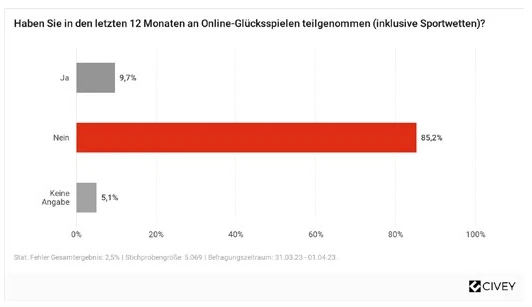
When examining the distribution of genders, it becomes apparent that twice as many men as women engaged in gambling. It was 12.8% of men and 6.5% of women who took part. Notably, 88.3% of women refrained from playing in the past 12 months, while among men, this figure stood at 82.1%.
The age group between 30 and 39 shows a high level of activity, with 15.7% of individuals engaging in playful pursuits. Conversely, only 5.9% of individuals aged 65 and above participated in gambling activities. In terms of education, no significant disparities were observed.
15.3% are in favor of legal gambling for enhanced safety.
According to a survey conducted by the DGGS, 15.3% of respondents expressed their support for the need for more legal options for gambling enthusiasts. However, a notable 35.2% disagreed, seemingly perceiving it as less significant to have access to legal gaming options.
The age group that shows the highest approval is the 30 to 39-year-olds. Even 51.5% of this age group support it. Following with a 37.3% approval rate is the 40 to 49 age group. The lowest approval came from individuals over 65.
Lotto emerges as the most popular form of gambling among the survey participants.
Among the various forms of gambling, it appears that lottery is the most popular. A total of 81.7% of respondents stated that they had played lotteries online at least once in the last 12 months. Online slot machines garnered a 7% vote. Surprisingly, 16.2% took part in sports betting. Online poker was played by 5.4% of the survey participants. (Source: DGGS)
At least 5.4% of the surveyed individuals engaged in playing roulette, while 3% opted for blackjack. Horse betting was pursued by 2.2% of participants. Lotteries, however, hold significant importance. Additionally, the slot machines showcase their appeal. Regarding the distribution of genders, there were no substantial distinctions. Both women and men participated in lotteries, with rates of 81% and 82% respectively.
The willingness to spend varies significantly. 12% of participants would be willing to spend a maximum of 50€. 24.1% would spend up to 10€ per round. 21.6% of respondents could even imagine spending up to 20€. However, there are also 6.7% who would bet over 50€ per game.
Conclusion: The DGGS study represents a significant milestone in promoting transparency within the gambling industry.
The gambling industry in Germany is undergoing a transformation. The introduction of the new State Treaty on Gambling and the establishment of the Joint Gambling Authority of the German States (GGL) (JGA) now provide an official regulatory framework for online gambling in Germany. Finally, the long-awaited era of legalized online gambling has arrived in the country.
The research conducted by the DGGS represents a significant stride towards fostering transparency within the industry. Feel free to download the comprehensive study here. Furthermore, our website will feature additional articles on the topic in the coming days.